
Why Business Transformation Fails Without Strong Execution
Many businesses create ambitious transformation strategies but struggle to turn those plans into measurable results. This article explains why execution, ownership, technology, communication, and continuous improvement are essential for successful transformation.
Why Business Transformation Fails Without Strong Execution
Business transformation is often presented as a technology project. Organizations invest in new software, redesign their processes, introduce automation, and create strategic plans. However, transformation is not successful merely because a new system has been installed or a strategy document has been approved.
True transformation happens when an organization changes how it thinks, operates, serves customers, makes decisions, and creates value. It requires alignment between people, processes, technology, leadership, and measurable business outcomes.
Many transformation projects fail not because the strategy is completely wrong, but because the organization is unable to execute it consistently.
What Business Transformation Really Means
Business transformation is the process of making significant and lasting improvements to the way an organization operates and grows.
It may involve:
- Redesigning internal processes
- Improving customer experiences
- Introducing digital platforms
- Automating repetitive work
- Creating new products or services
- Strengthening decision-making
- Improving collaboration between departments
- Developing new business models
- Building a more adaptable organization
Transformation is broader than digitalization. Digitalization may involve converting manual processes into digital workflows. Transformation goes further by changing the way the business works as a whole.
For example, replacing paper invoices with digital invoices is digitalization. Redesigning the entire finance workflow to improve approval speed, reduce errors, connect with accounting software, and provide real-time financial visibility is business transformation.
The objective is not to use technology simply because it is available. The objective is to create a more efficient, responsive, scalable, and sustainable business.
Why Strategy Alone Is Not Enough
A strategy explains where an organization wants to go. Execution determines whether it actually gets there.
Many organizations create detailed transformation plans containing goals, timelines, budgets, and technology recommendations. However, these plans often fail when they reach day-to-day operations.
A strategy may recommend:
- Improving customer service
- Reducing operational costs
- Adopting artificial intelligence
- Expanding into new markets
- Creating better reporting systems
- Modernizing the technology infrastructure
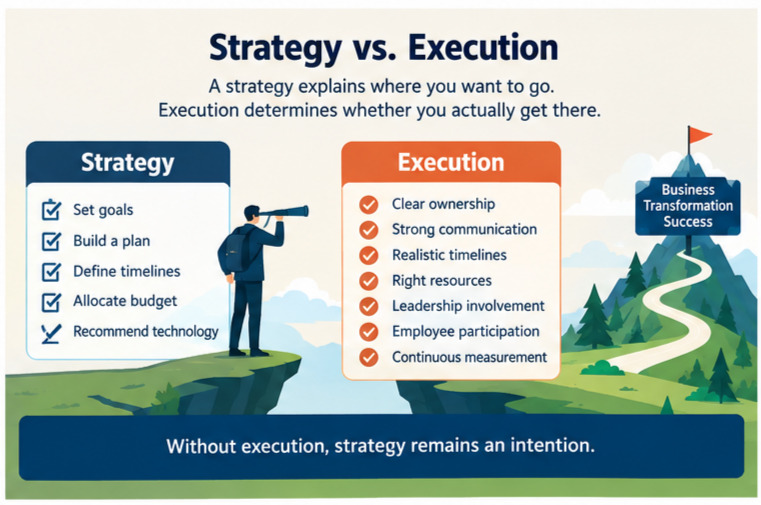
These goals are valuable, but they are not enough by themselves. Teams need to understand what actions must be taken, who is responsible, what resources are available, and how progress will be measured.
Without execution, strategy remains an intention.
Successful execution requires:
- Clear ownership
- Strong communication
- Realistic timelines
- Appropriate resources
- Leadership involvement
- Employee participation
- Practical systems
- Continuous measurement
The gap between strategy and execution is where many transformation projects lose momentum.
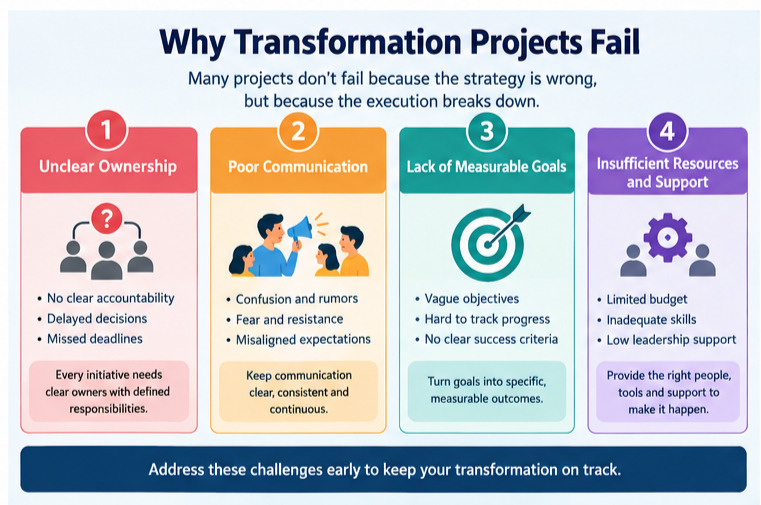
Common Reasons Transformation Projects Fail
1. Unclear Ownership
Transformation projects often involve multiple departments, external partners, and senior leaders. When responsibility is spread across too many people without clear accountability, important tasks can be delayed or ignored.
Every major transformation initiative should have clearly assigned owners. These owners should understand:
- What outcome they are responsible for
- What decisions they can make
- Which teams they depend on
- What deadlines they must meet
- How their performance will be evaluated
Ownership does not mean that one person must complete everything. It means that one person or team is responsible for ensuring that the work moves forward.
2. Poor Internal Communication
Employees may resist transformation when they do not understand why it is happening or how it will affect their work.
Poor communication can create:
- Confusion
- Rumors
- Fear of job loss
- Departmental resistance
- Repeated work
- Misaligned expectations
Communication should begin before implementation starts. Leaders should explain the reason for the transformation, the expected benefits, the potential challenges, and the role employees will play.
Communication must also be continuous. A single announcement is not enough. Teams need regular updates, opportunities to ask questions, and clear explanations when plans change.
3. Lack of Measurable Goals
A transformation project cannot be managed effectively if success has not been defined.
Statements such as “improve efficiency” or “become more digital” are too broad to measure. They should be converted into specific outcomes, such as:
- Reduce approval time from ten days to three days
- Decrease customer response time by 40 percent
- Reduce manual data entry by 60 percent
- Increase online conversions by 25 percent
- Improve reporting accuracy to 98 percent
- Reduce operational costs by a defined amount
Measurable goals help organizations determine whether their investment is producing meaningful results.
4. Resistance to Change
Resistance is a natural response to uncertainty. Employees may be comfortable with existing processes, even when those processes are inefficient.
Resistance often develops when people believe that:
- Their experience is being ignored
- New systems will make their work harder
- The transformation is being imposed without consultation
- They will not receive proper training
- Their roles may become less secure
Organizations can reduce resistance by involving employees early, listening to their concerns, providing training, and showing how the change will improve their work.
Change management should be treated as a central part of transformation, not as an afterthought.
5. Disconnected Technology Systems
A business may use several tools that do not communicate with each other. Customer information may be stored in one system, financial data in another, and operational information in spreadsheets.
Disconnected systems create:
- Duplicate data
- Manual work
- Reporting delays
- Inconsistent information
- Poor customer experiences
- Increased security risks
Technology should be selected and integrated according to business requirements. Adding more software without improving system connectivity can make operations more complex instead of improving them.
How Leadership Supports Successful Execution
Leadership has a direct influence on whether transformation succeeds.
Leaders must provide more than approval and funding. They need to create direction, remove obstacles, communicate consistently, and demonstrate commitment through their own actions.
Effective leadership includes:
- Defining a clear transformation vision
- Establishing realistic priorities
- Supporting cross-functional cooperation
- Making timely decisions
- Allocating the necessary resources
- Holding teams accountable
- Recognizing progress
- Addressing resistance constructively
Leaders should also accept that transformation may require experimentation. Not every initiative will produce the expected result immediately. A learning-oriented culture allows teams to test ideas, review outcomes, and make improvements.
When leaders continue using outdated processes while asking employees to change, the organization receives a conflicting message. Leadership behavior must reflect the transformation being promoted.
Creating an Execution Roadmap
A transformation roadmap converts a broad strategy into practical stages.
A strong roadmap normally includes:
Current-State Assessment
The organization must first understand how it operates today. This includes reviewing processes, systems, roles, customer experiences, costs, risks, and performance gaps.
Future-State Definition
The organization should define what the desired future looks like. This may include improved processes, new technology, clearer responsibilities, better customer experiences, and measurable business outcomes.
Priority Identification
Not every improvement can be implemented at once. Projects should be prioritized based on:
- Business impact
- Urgency
- Cost
- Complexity
- Risk
- Available resources
- Dependencies
Implementation Phases
Large transformation programs should be divided into manageable phases. A typical structure might include:
- Assessment and planning
- Process redesign
- Technology selection
- Pilot implementation
- Employee training
- Wider rollout
- Measurement and optimization
Review Points
Each phase should include review points where leaders assess progress, risks, spending, and results. This makes it possible to adjust the roadmap before small issues become major failures.
Aligning People, Processes, and Technology
Transformation works best when people, processes, and technology are designed together.
Technology alone cannot solve a poorly designed process. Similarly, a well-designed process will not produce results if employees do not understand it or the supporting systems are unreliable.
People
Employees need the skills, confidence, and authority to work in the new environment. Training should be practical and connected to their daily responsibilities.
Processes
Processes should be reviewed before automation. Automating a broken process may simply make the inefficiency happen faster.
Technology
Technology should support the organization’s objectives. It should be secure, scalable, maintainable, and suitable for the people expected to use it.
A successful transformation creates alignment between all three areas. Employees understand the process, the process supports business goals, and technology enables the process effectively.
Measuring Transformation Progress
Measurement should take place throughout the transformation, not only at the end.
Useful measurement areas include:
- Financial performance
- Operational efficiency
- Customer satisfaction
- Employee adoption
- Process completion times
- Error rates
- System usage
- Revenue growth
- Cost reduction
- Project delivery performance
Both leading and lagging indicators should be used.
Leading indicators show whether the project is moving in the right direction. Examples include training completion, system adoption, and process participation.
Lagging indicators show the final results. Examples include reduced costs, improved customer retention, and increased revenue.
Regular reporting allows leaders to identify problems early and make evidence-based decisions.
The Importance of Continuous Improvement
Transformation is not a one-time event. Markets change, customer expectations evolve, and technology continues to develop.
Even after a new system or process has been launched, organizations should continue to review:
- What is working well
- What employees find difficult
- Whether customers are receiving better service
- Whether the expected business benefits are being achieved
- Which processes require further improvement
Continuous improvement may involve small adjustments rather than major projects. Improving a report, simplifying an approval step, removing duplicate data entry, or refining an automated workflow can produce significant long-term benefits.
Organizations that treat transformation as an ongoing discipline are more likely to remain adaptable and competitive.
Practical Checklist for Transformation Readiness
Before starting a transformation program, an organization should ask:
- Is the business reason for transformation clearly defined?
- Are the expected outcomes measurable?
- Has senior leadership committed to the initiative?
- Is ownership clearly assigned?
- Have employees been involved in the planning process?
- Are current processes documented?
- Are technology gaps understood?
- Is the budget realistic?
- Are the required skills available?
- Is there a communication plan?
- Is employee training included?
- Have risks and dependencies been identified?
- Will progress be reviewed regularly?
- Is there a plan for continuous improvement?
If several answers are unclear, the organization may need additional preparation before implementation begins.
Conclusion: Turning Plans Into Business Outcomes
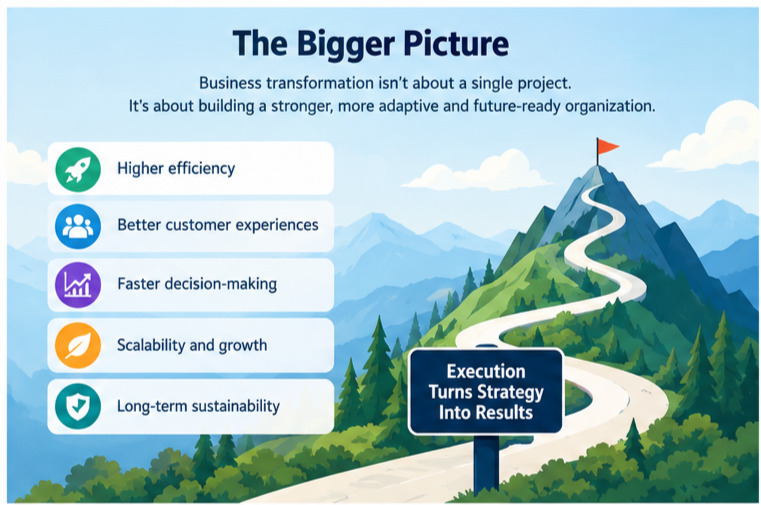
Business transformation succeeds when strategy becomes coordinated action.
A strong strategy provides direction, but execution creates results. Organizations must establish clear ownership, communicate effectively, measure progress, manage resistance, and align people, processes, and technology.
The most successful transformation programs are practical, measurable, and connected to real business needs. They do not focus only on acquiring new technology. They focus on improving how the organization works and how it creates value for customers.
Transformation is not simply about becoming more digital. It is about becoming more capable, more responsive, and better prepared for the future.