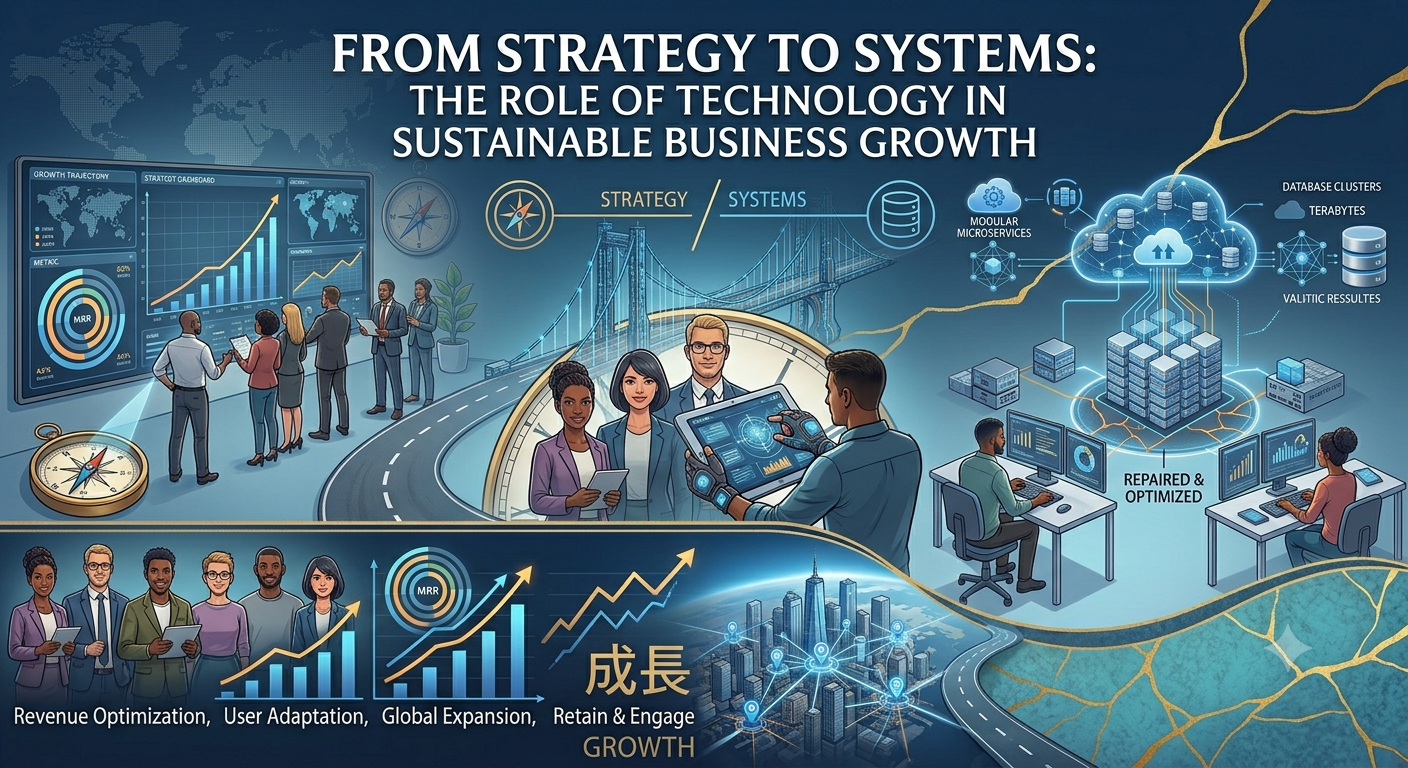
From Strategy to Systems: The Role of Technology in Sustainable Business Growth
Technology creates the greatest value when it supports a clear business strategy. This article explores how companies can connect leadership decisions, operational processes, digital systems, and measurable business goals.
Technology has become a central part of how modern businesses operate, compete, and grow. Companies use digital platforms to communicate with customers, manage operations, analyze data, automate tasks, and deliver products and services.
However, technology creates the greatest value when it supports a clear business strategy. Simply purchasing new software or adopting the latest digital trend does not guarantee better performance. Technology must be connected to real business priorities, measurable outcomes, and the way people work.
When strategy and technology are aligned, businesses can improve efficiency, make better decisions, and build sustainable growth.
Why Technology Should Follow Business Objectives
Technology should be selected because it solves a business problem or creates a meaningful opportunity.
Before investing in a new system, organizations should ask:
- What business problem are we trying to solve?
- Which process needs improvement?
- Who will use the system?
- What result do we expect?
- How will success be measured?
- What risks could the technology introduce?
Without clear objectives, technology investments can become expensive experiments. A company may purchase several tools that duplicate one another, create disconnected data, or increase complexity for employees.
Business objectives may include:
- Improving customer response times
- Reducing operational costs
- Increasing sales
- Improving reporting
- Supporting remote collaboration
- Reducing manual work
- Entering new markets
- Strengthening data security
- Improving product quality
Once the objective is defined, technology can be evaluated based on how effectively it supports that goal.
The Relationship Between Strategy and Execution
Strategy defines direction. Execution turns that direction into results.
A business strategy may identify the need to improve customer experience, expand operations, or become more efficient. Execution determines the processes, people, systems, and actions required to achieve those goals.
Technology often acts as the connection between strategy and execution.
For example, a company may have a strategy to improve customer retention. Execution may involve:
- Centralizing customer information
- Creating a customer support process
- Automating follow-up communication
- Tracking customer feedback
- Monitoring retention metrics
Technology can support each of these activities, but it cannot replace the strategy itself.
Successful execution requires:
- Clear ownership
- Defined processes
- Appropriate tools
- Employee participation
- Regular measurement
- Leadership support
When these elements work together, technology becomes an enabler of business performance rather than an isolated investment.
Identifying Operational Inefficiencies
Before introducing new technology, businesses should examine how work is currently completed.
Operational inefficiencies may appear as:
- Repeated manual data entry
- Slow approval processes
- Duplicate records
- Poor communication between departments
- Unclear responsibilities
- Delayed reporting
- Frequent errors
- Unnecessary meetings
- Difficult document retrieval
- Systems that do not communicate with each other
These problems often remain hidden because employees become accustomed to working around them.
A process review can reveal where time is being lost and where customers or employees experience unnecessary friction.
Useful questions include:
- Which tasks take the most time?
- Where do delays occur?
- Which activities are repeated?
- Where do errors happen most frequently?
- Which information is difficult to access?
- Which tasks depend on one individual?
- Where are spreadsheets being used to manage important operations?
Technology should be introduced after these inefficiencies are understood.
Selecting Technology Based on Real Business Needs
There is no single technology solution that is right for every organization.
Businesses should consider:
- Company size
- Industry requirements
- Budget
- Existing systems
- Security needs
- Employee capabilities
- Expected growth
- Integration requirements
- Support and maintenance
A smaller organization may benefit from a simple cloud-based platform, while a larger organization may require customized software and more advanced infrastructure.
The most expensive or sophisticated solution is not always the best choice. The right solution is one that solves the problem effectively and can be maintained over time.
Technology selection should also consider total cost. This includes:
- Licensing
- Implementation
- Customization
- Training
- Data migration
- Support
- Security
- Future upgrades
A solution that appears inexpensive initially may become costly if it requires extensive manual work or frequent technical support.
Improving Collaboration Through Digital Systems
As businesses grow, collaboration becomes more complex. Teams may work across locations, departments, and time zones.
Digital systems can improve collaboration by providing:
- Shared project information
- Centralized documents
- Task management
- Communication history
- Workflow visibility
- Automated notifications
- Clear approval processes
- Real-time reporting
Centralized systems reduce the risk of important information being stored in personal inboxes or disconnected files.
For collaboration tools to be effective, employees need clear guidelines. The organization should define:
- Where information should be stored
- Which communication channels should be used
- How tasks should be assigned
- Who can approve work
- How documents should be named
- How long records should be retained
Technology improves collaboration when it creates clarity rather than adding more channels and complexity.
Using Data for Better Management Decisions
Data allows leaders to make decisions based on evidence rather than assumptions.
Businesses can use data to understand:
- Revenue performance
- Customer behavior
- Operational costs
- Employee productivity
- Product usage
- Marketing results
- Service quality
- Project progress
- Inventory movement
However, data is useful only when it is accurate, accessible, and interpreted correctly.
Organizations should establish consistent definitions for important metrics. For example, different departments should not use different definitions of “active customer,” “completed project,” or “qualified lead.”
Good data management requires:
- Reliable data sources
- Clear ownership
- Consistent reporting
- Appropriate access controls
- Regular data quality reviews
- Secure storage
- Useful visualization
Dashboards should focus on information that supports decisions. Producing large volumes of data without identifying what actions should follow can make decision-making more difficult.
Connecting Different Tools and Platforms
Many businesses use separate systems for sales, finance, support, human resources, marketing, and operations.
When these systems are disconnected, employees may need to copy information manually from one platform to another. This creates delays and increases the possibility of errors.
Integrating systems can help businesses:
- Reduce duplicate data entry
- Improve reporting
- Create a unified customer view
- Automate workflows
- Improve accuracy
- Reduce administrative work
- Support faster decisions
Integration should be planned carefully. Businesses must consider:
- Which systems need to exchange data
- What information should be shared
- How frequently it should be synchronized
- Which system is the primary source
- How errors will be handled
- How access will be secured
Not every system needs to be connected. Integrations should support clear business outcomes and avoid unnecessary technical complexity.
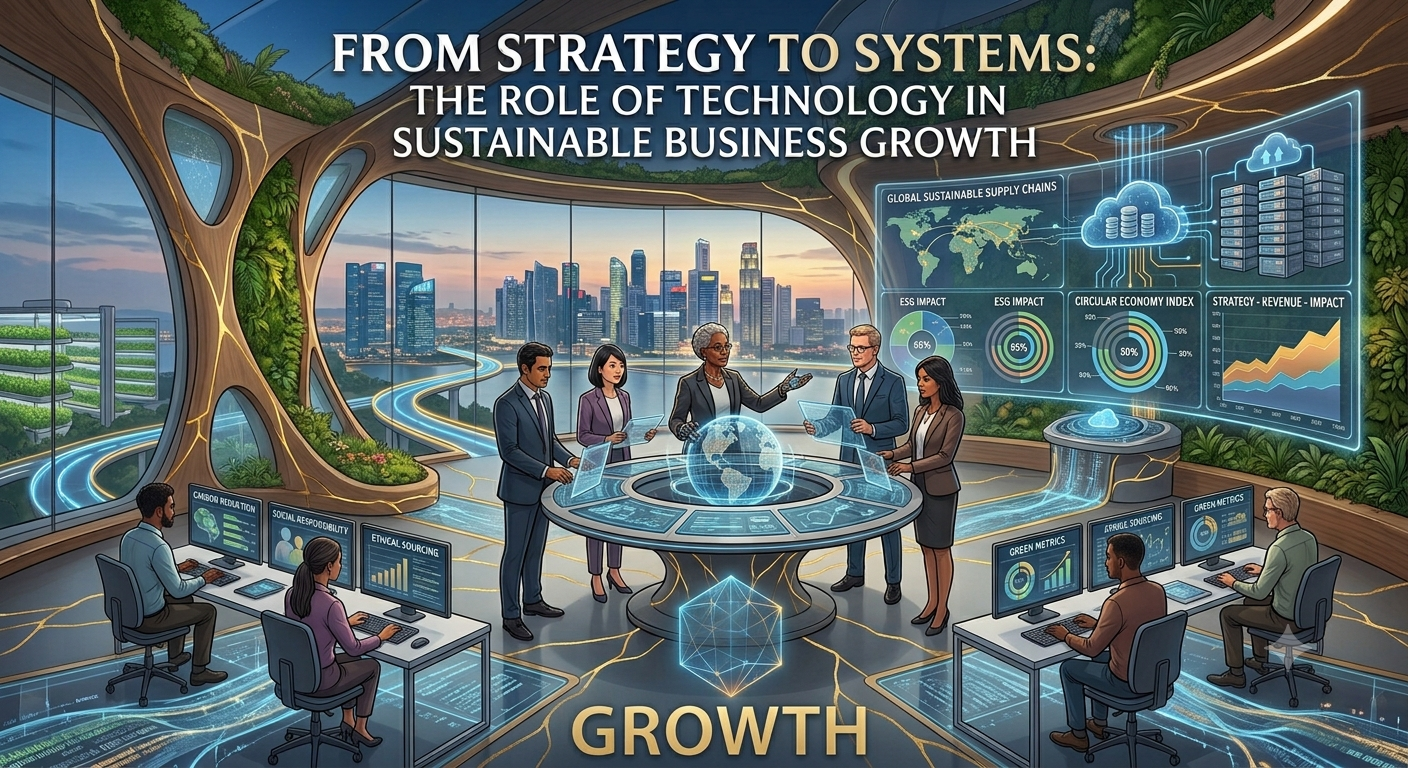
Supporting Sustainable and Responsible Growth
Sustainable growth means increasing business performance without creating unnecessary operational, financial, or environmental strain.
Technology can support sustainable growth by helping businesses:
- Automate repetitive work
- Reduce paper-based processes
- Improve resource planning
- Monitor energy usage
- Reduce travel requirements
- Optimize supply chains
- Improve remote collaboration
- Track sustainability indicators
- Reduce waste
- Improve asset utilization
Technology also helps businesses scale more responsibly. A well-designed system can support more customers and transactions without requiring the same increase in manual effort.
Responsible growth requires careful consideration of data, privacy, accessibility, security, and environmental impact. Businesses should understand not only what technology can do, but also how it affects employees, customers, and communities.
Balancing Innovation With Stability
Innovation is important, but constant change can create instability.
Businesses may be tempted to adopt every new platform, AI tool, or development framework. However, frequent changes can cause:
- Employee confusion
- Integration problems
- Increased training requirements
- Higher costs
- Security risks
- Lack of consistency
A stable technology environment does not mean refusing to innovate. It means introducing innovation through a controlled process.
Organizations can balance innovation and stability by:
- Testing new solutions through pilots
- Evaluating measurable benefits
- Reviewing security risks
- Training employees
- Maintaining reliable core systems
- Introducing changes gradually
- Documenting technology decisions
Innovation should strengthen the business rather than disrupt essential operations unnecessarily.
Building a Long-Term Technology Roadmap
A technology roadmap connects present priorities with future requirements.
A strong roadmap should include:
Current-State Review
Document the existing systems, processes, risks, costs, and limitations.
Business Priorities
Identify the most important short-term and long-term business objectives.
Technology Gaps
Determine which existing systems are unable to support current or future requirements.
Priority Initiatives
Rank proposed projects according to impact, urgency, complexity, cost, and risk.
Implementation Timeline
Create realistic phases for planning, development, testing, training, and deployment.
Ownership and Governance
Assign responsibility for each initiative and establish decision-making processes.
Review and Adjustment
Revisit the roadmap regularly as business conditions, customer expectations, and technology options change.
A roadmap should provide direction without becoming inflexible. It must be updated when new information becomes available.
Measuring the Business Impact of Technology
Technology investments should be evaluated according to the value they create.
Useful measures include:
- Revenue growth
- Cost reduction
- Time saved
- Faster customer response
- Improved customer satisfaction
- Reduced error rates
- Increased employee productivity
- Higher system adoption
- Better reporting accuracy
- Improved project delivery
- Reduced security incidents
Measurement should begin before implementation so that the organization has a clear baseline for comparison.
For example, if a company wants to improve customer support, it should record current response times, resolution times, customer satisfaction, and ticket volumes before introducing a new system.
Business impact may not always appear immediately. Some technology investments create long-term value through better data, improved adaptability, stronger customer relationships, or reduced operational risk.
Common Mistakes to Avoid
Choosing Technology Before Defining the Problem
A tool should support a business need, not create a reason to use the tool.
Ignoring Employees
Employees understand daily operations and should be involved in evaluating new systems.
Failing to Plan Integration
Disconnected systems can create more manual work and inconsistent data.
Underestimating Training
A system cannot create value if employees do not understand how to use it.
Measuring Activity Instead of Outcomes
The number of licenses purchased or features launched does not prove business success.
Neglecting Security
Security should be considered during planning, implementation, and ongoing maintenance.
Creating Excessive Complexity
More systems and features do not necessarily produce better results.
Conclusion: Technology as an Execution Layer for Growth
Technology is most valuable when it helps a business execute its strategy more effectively.
The strongest organizations do not adopt technology simply to appear modern. They use it to improve decisions, simplify operations, support employees, serve customers, and create measurable business outcomes.
Sustainable technology adoption requires:
- Clear business objectives
- Strong operational understanding
- Appropriate system selection
- Connected workflows
- Reliable data
- Employee participation
- Security and governance
- Continuous measurement
Technology should not replace leadership, strategy, or human judgment. It should strengthen them.
When businesses connect strategy with practical systems, they create an operating foundation capable of supporting long-term growth, innovation, and resilience.