
How AI and Automation Are Changing Modern Business Operations
AI and automation are helping businesses reduce repetitive work, improve decision-making, and create more efficient operations. This article explains how organizations can adopt these technologies responsibly and practically.
Artificial intelligence and automation are changing how modern businesses operate. Organizations are using these technologies to reduce repetitive work, improve decision-making, respond to customers faster, and create more efficient internal processes.
However, successful adoption is not simply about purchasing an AI tool or automating as many tasks as possible. Businesses must understand where these technologies create genuine value, how they affect employees, and how to introduce them responsibly.
The most effective approach is practical, measured, and connected to clear business objectives.
Understanding AI and Business Automation
Business automation involves using software to perform tasks with limited human intervention. These tasks usually follow predefined rules.
Examples include:
- Sending automated email notifications
- Generating invoices
- Updating customer records
- Moving data between systems
- Scheduling appointments
- Creating routine reports
- Assigning support requests
Artificial intelligence goes further by enabling systems to analyze information, recognize patterns, understand language, and generate recommendations or content.
AI-powered systems can:
- Understand customer questions
- Summarize documents
- Identify unusual patterns in data
- Recommend products or actions
- Predict demand
- Classify information
- Generate written content
- Assist with business analysis
Automation focuses primarily on performing tasks. AI focuses on analyzing information and supporting decisions. When combined, they can improve entire workflows.
The Difference Between Automation and AI
Traditional automation generally follows fixed instructions.
For example:
If a customer submits a form, send a confirmation email and create a record in the CRM.
AI-based systems can handle more complex and less predictable situations.
For example:
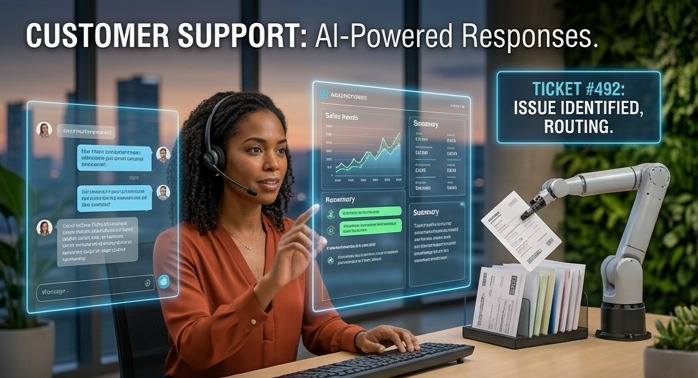
Analyze a customer’s message, identify the issue, determine its urgency, and route it to the appropriate department.
Automation is usually predictable and rule-based. AI is more flexible but may produce inaccurate results if it receives incomplete or misleading information.
Both have important roles. Businesses should not use AI when simple automation is sufficient. A straightforward rule-based workflow may be more reliable, less expensive, and easier to maintain.
Business Processes Suitable for Automation
Customer Support
AI-powered chat systems can answer common customer questions, provide product information, track support requests, and route complex issues to human employees.
Automation can also help with:
- Ticket creation
- Follow-up messages
- Customer notifications
- Frequently asked questions
- Support prioritization
- Service-status updates
Human representatives should remain available for sensitive, complex, or unusual problems.
Data Entry
Data entry is often repetitive and time-consuming. Automation can extract information from forms, invoices, emails, and documents and transfer it into business systems.
This can reduce:
- Manual typing
- Duplicate records
- Data-entry errors
- Processing delays
- Administrative workload
Automated data extraction should still include validation, especially when the information affects financial, legal, or customer records.
Reporting
Businesses often spend significant time collecting information from different systems and preparing recurring reports.
Automation can:
- Collect data on a schedule
- Update dashboards
- Generate performance summaries
- Notify managers about unusual changes
- Distribute reports automatically
AI can assist by explaining trends and identifying information that requires attention.
Marketing Workflows
Marketing teams can automate many routine activities, including:
- Email campaigns
- Lead notifications
- Customer segmentation
- Social media scheduling
- Campaign reporting
- Follow-up reminders
- Content recommendations
AI can help create initial drafts, analyze campaign performance, and identify patterns in customer behavior. Human review remains important to maintain accuracy, brand consistency, and appropriate communication.
Document Processing
Organizations handle contracts, applications, invoices, reports, and policy documents every day. AI can help extract key information, summarize documents, classify files, and identify missing data.
This can improve document processing speed while allowing employees to focus on review and decision-making.
How AI Improves Decision-Making
AI can process large amounts of information faster than a person working manually. It can identify patterns that may not be immediately visible and provide useful insights for management.
Examples include:
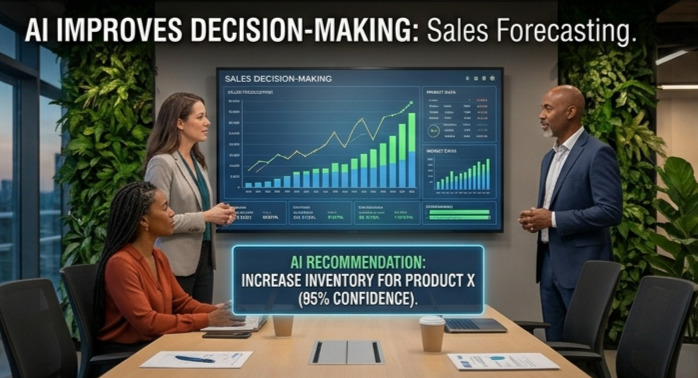
- Forecasting sales demand
- Identifying customer churn risks
- Detecting unusual financial activity
- Comparing operational performance
- Predicting inventory requirements
- Analyzing customer feedback
- Identifying delays in business processes
AI should support decision-making rather than replace responsibility. Managers must understand the basis of recommendations and consider business context before taking action.
An AI recommendation should be treated as an input into a decision, not as an unquestionable answer.
Benefits for Growing Businesses
AI and automation can provide several advantages for growing organizations.
Increased Efficiency
Automating routine tasks allows employees to focus on customer service, problem-solving, innovation, and strategic work.
Lower Operational Costs
Automation can reduce the time required for repetitive activities and allow businesses to handle greater volumes without increasing administrative overhead at the same rate.
Faster Customer Response
Automated responses and intelligent routing can help customers receive information more quickly.
Better Data Visibility
Connected systems and automated reporting give leadership teams more reliable access to operational information.
Improved Consistency
Automated processes follow the same rules each time, reducing variation and human error.
Easier Scalability
A well-designed automated workflow can support additional customers, transactions, or employees without requiring the same level of manual effort.
Risks and Challenges
Data Privacy
AI systems may process customer information, employee records, financial data, or confidential business documents. Organizations must understand where data is stored, who can access it, and how it is used.
Sensitive information should not be entered into AI tools without appropriate safeguards.
Security
Automation increases the number of connections between systems. If these connections are poorly secured, they may create new risks.
Businesses should apply:
- Strong authentication
- Role-based access
- Encryption
- Regular security reviews
- Activity monitoring
- Secure API management
Incorrect AI Outputs
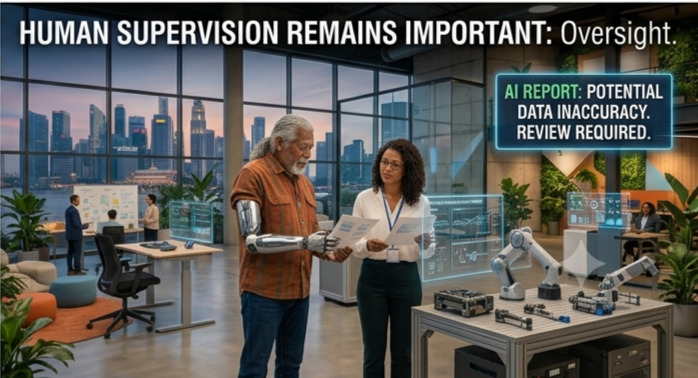
AI systems can produce incorrect, incomplete, or misleading information. This is especially important when AI is used for financial, legal, medical, or strategic decisions.
Important outputs should be reviewed by qualified employees before being used.
Employee Adoption
Employees may be concerned that automation will replace their roles or make their work more difficult. Poorly introduced technology can reduce trust and create resistance.
Organizations should explain:
- Why the technology is being introduced
- Which tasks will change
- How employees will benefit
- What training will be provided
- Which decisions will remain human responsibilities
Poor Process Design
Automating an inefficient process does not automatically improve it. It may simply allow the organization to perform a flawed process more quickly.
Businesses should review and simplify processes before automating them.
How to Identify the Right Automation Opportunities
Businesses should begin with a process review rather than a technology purchase.
A suitable automation opportunity usually has several of these characteristics:
- It is repetitive
- It follows clear rules
- It requires significant manual effort
- It has a high error rate
- It creates delays
- It involves multiple systems
- It has measurable outcomes
- It does not require constant human judgment
A simple evaluation framework can ask:
- How often does the process occur?
- How much employee time does it require?
- How costly are errors?
- How predictable is the process?
- What data does it use?
- What risks could automation introduce?
- How will improvement be measured?
The best starting point is often a small, high-volume process with clear benefits.
Building an AI Adoption Roadmap
A structured roadmap helps organizations avoid rushed or disconnected technology decisions.
Step One: Define Business Objectives
The organization should first identify the problem it wants to solve. Examples include reducing support delays, improving reporting, or lowering administrative costs.
Step Two: Assess Current Processes
Document the current workflow, including people, systems, approvals, data sources, and common problems.
Step Three: Prioritize Opportunities
Rank possible initiatives according to business impact, complexity, cost, risk, and readiness.
Step Four: Select Appropriate Tools
The selected technology should match the organization’s requirements. Businesses should consider integration, security, scalability, usability, and long-term maintenance.
Step Five: Run a Pilot
A small pilot allows the organization to test the solution with limited risk. Feedback should be collected from both employees and customers where appropriate.
Step Six: Train Users
Training should explain not only how to use the system, but also when human review is required and how errors should be reported.
Step Seven: Measure Results
The organization should compare performance before and after implementation using defined metrics.
Step Eight: Expand Carefully
Successful pilots can be expanded gradually. Each new phase should be reviewed before additional complexity is introduced.
Why Human Supervision Remains Important
AI can process information quickly, but it does not possess complete business context, accountability, or human judgment.
Human supervision is important when:
- Decisions affect customers significantly
- Information is confidential
- The situation is unusual
- The output is uncertain
- Legal or financial consequences are possible
- Ethical considerations are involved
- The system is making recommendations rather than following simple rules
The best operating model combines machine efficiency with human judgment. AI should handle appropriate repetitive work while people remain responsible for oversight, relationships, creativity, and critical decisions.
Measuring Return on Investment
AI and automation projects should be measured against business outcomes rather than technical activity.
Useful metrics include:
- Time saved
- Reduction in processing costs
- Fewer manual errors
- Faster response times
- Improved customer satisfaction
- Increased conversion rates
- Higher employee productivity
- Reduced operating costs
- Improved reporting accuracy
- Increased revenue
Organizations should also measure adoption. A technically successful system will not create value if employees do not use it correctly.
Return on investment may include more than direct financial savings. Improved customer experiences, faster decisions, better employee satisfaction, and stronger data quality can also produce long-term value.
Conclusion: Adopting AI With Purpose
AI and automation can help businesses become faster, more efficient, and more adaptable. They can reduce repetitive work, improve customer service, strengthen reporting, and support better decisions.
However, technology should not be introduced simply because it is popular or available. Businesses should begin with real operational problems and select solutions that support clear objectives.
Successful adoption requires:
- Strong process understanding
- Appropriate technology selection
- Secure data practices
- Employee involvement
- Human supervision
- Measurable goals
- Continuous improvement
The future of business will not be defined only by how much automation an organization uses. It will be defined by how thoughtfully it combines technology with human expertise.
Businesses that adopt AI with purpose can improve performance while creating more meaningful and productive work for their people.